GuidesPredictionsPart 1 of 2
Why Everyday Traders Are Turning to Prediction Markets
Know a subject well? Learn how to put your knowledge to work in prediction markets, estimate and evaluate potential payouts, and decide whether the odds are worth a punt.
8 min readUpdated October 30, 2026
You’ve done your homework and think the Fed will cut rates. So you buy stocks or a call option; the cut happens, and stocks fall anyway. You got the news right, but the trade still lost money.
If you’ve ever placed a stock trade ahead of a Fed decision, inflation report or election, this might sound familiar.
With a prediction market, you can bet on the rate cut event itself!
Will the Fed cut interest rates at its next meeting? Will Bitcoin reach a specified price before the end of the year? Will a company launch its product by a particular date?
For everyday traders, that is an appealing change.
Find a market or niche you’re interested in, check the odds and decide whether to bet Yes or No.
In this article, we’ll explain how the prediction market works, why the market has grown so fast and where a smaller trader might find an opportunity. We’ve also built a free prediction markets page on our website gnosisfi.com where you can follow live odds, data, and use our free prediction tools to calculate your math before betting.
You’ll find the link at the bottom of this article.
How the Bet Works
Say you think the Fed will cut rates at its next meeting. You find that market and buy Yes at 40 cents.
If the Fed cuts rates and Yes wins under the market’s rules, you receive $1 per contract, making a 60-cent profit before fees. If No wins, you lose the 40 cents you paid.
That 40-cent price suggests traders are giving the cut roughly a 40% chance. You’re backing it because you think the chances are better than that.
Always double-check the price on your order before buying. The percentage displayed on Polymarket usually sits halfway between the highest buying price and the lowest selling price, so it may differ from what you actually pay.
Here is a hypothetical purchase:
100 Yes contracts at 40 cents | Result |
|---|---|
Purchase cost | $40 |
Payout if Yes wins | $100 |
Profit if Yes wins | $60 |
Loss if No wins | $40 |
This example assumes you hold until normal resolution and excludes fees. Polymarket’s resolution documentation confirms that winning shares pay $1 and losing shares become worthless.
Why This Appeals to the Smaller Trader
Put What You Know to Work
Start with what you already spend time following, studying, or find interesting. Maybe you’re always checking inflation data before a Fed meeting, following an election or keeping up with the latest economic or crypto developments.
Prediction markets give you a way to trade that knowledge directly. If you’ve researched the next Fed decision, you can bet on that decision instead of trying to work out which stock or option to buy.
That’s what we like about them. You can focus on a subject you know well and look for a price you think is worth taking. Your research could help you spot something other traders have missed, although knowing the subject doesn’t guarantee a winning bet.
The math is easier to understand than more complex instruments. In our 40-cent Yes example, you know before buying that each contract could make 60 cents or lose the 40 cents you paid, before fees. You don’t have to calculate how an option’s value might change as time runs down.
Getting the results right matters, but so does what you pay.
Say you buy Yes at 95 cents. If you win, you receive $1, making just 5 cents before fees. If you lose, the whole 95 cents is gone.
Now suppose your research suggests the event has an 80% chance of happening. That sounds high, but paying 95 cents means the price is closer to a 95% chance. You think the outcome is likely, but you’re paying too much for that chance.
An unlikely outcome can offer better value. If your research puts its chances at 30% and Yes costs 20 cents, you’re paying less than your estimate suggests it’s worth. It could still lose, but that is the comparison to make: how likely do you think it is, and what are you paying?
How Big Have Prediction Markets Become?
A few years ago, most people had never used a prediction market. Let’s be honest, plenty hadn’t even heard of one. Had you? Now billions of dollars in contracts change hands every week, and what was once a niche corner of trading is reaching a much bigger crowd.
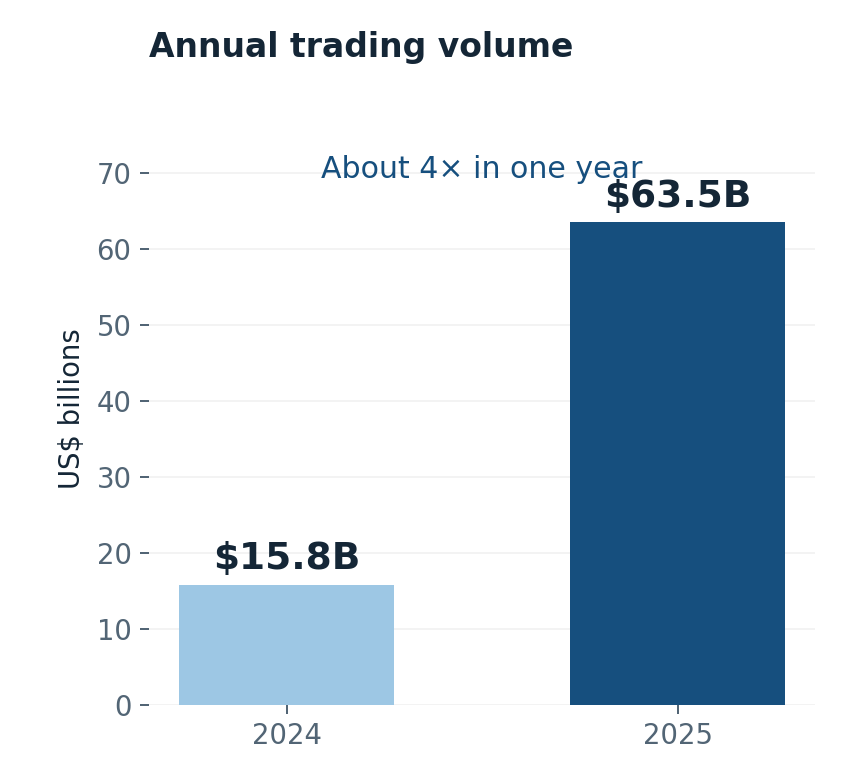
Across the platforms tracked by CoinGecko, annual trading volume rose from $15.8 billion in 2024 to $63.5 billion in 2025. That is roughly four times as much trading in one year.
Then activity picked up again in 2026.
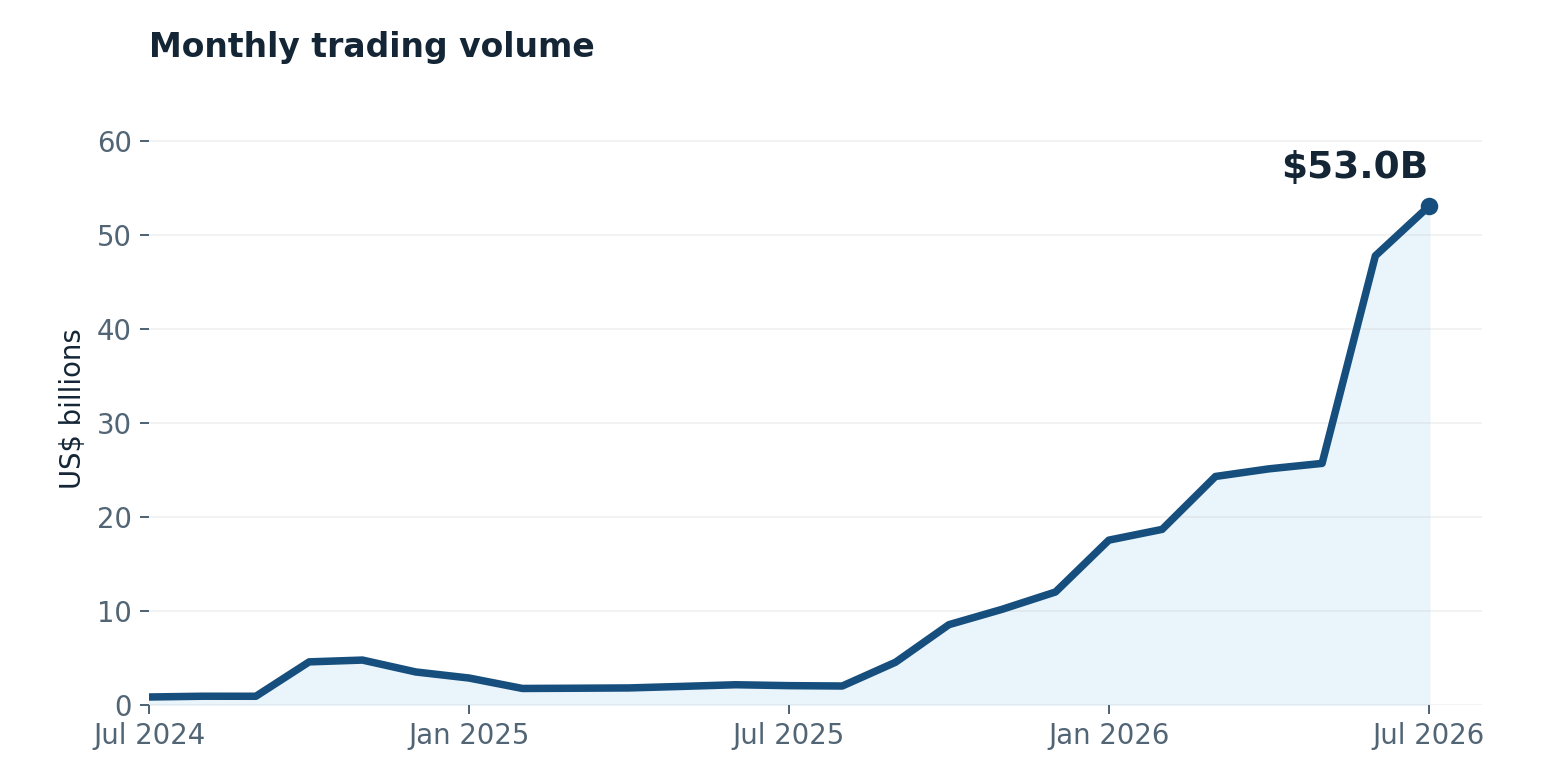
Pew Research Center’s analysis found that combined monthly trading on Kalshi and Polymarket, including Polymarket US, climbed from approximately $2 billion in July 2025 to $53 billion in July 2026. That is about 26 times the monthly activity a year earlier. Sports drove much of the increase, with the World Cup contributing to the summer surge.
It’s Reaching People Through Apps They Already Use
You no longer have to go looking for a specialist prediction platform to discover these markets. Robinhood has put event contracts inside an app its customers already use.
In the third quarter of 2026, Robinhood customers traded 16.4 billion event contracts. The business generated $173 million in revenue, more than equities trading at $121 million or crypto trading at $120 million individually. Options remained larger at $399 million.
Prediction markets are now a sizeable source of revenue for Robinhood, sitting alongside stocks, options and crypto. They also give people another reason to try the app, while introducing existing customers to a different way to trade.
Can Big Money Still Push the Market Around?
This deserves a direct answer: yes, prediction markets (just like stocks, options, futures) can still be manipulated, and insiders can still have an advantage.
Before you bet, the rules explain exactly what must happen for your bet to win. The concern is whether someone has inside information or can influence what happens. For example, someone involved in a product launch might know the announcement date before it becomes public. That’s different from betting on a Fed rate cut, where the little guy has the same odds; placing a large bet doesn’t give you control over the decision.
Kalshi’s own enforcement reports describe investigations involving political candidates trading on their own races and an employee trading in markets connected to information from their work. The CFTC has also issued an enforcement advisory about misconduct in prediction markets.
This is where it gets interesting for the smaller trader. A big player can place a bet that pushes the odds higher, but moving the odds doesn’t change the result. Betting millions on a Fed rate cut doesn’t make the Fed cut rates.
Say that buying pushes Yes from 40 cents to 60 cents. If your research suggests a cut is unlikely, you could look at No, now available at around 40 cents before fees. If the Fed leaves rates unchanged and No wins, it pays $1 per contract.
You don’t need to outspend the big trader. You need to get the result right at a price that makes the bet worthwhile. Bigger players still have advantages, but their buying can sometimes create a better price for someone willing to take the other side.
The Skill Is Knowing When the Price Is Wrong!
Imagine a contract costs 40 cents, and your research puts the chance of Yes at 55%.
Your hypothetical calculation for one contract would be:
55% × $1 payout − $0.40 cost = $0.15 expected profit before fees.
“Expected profit” is a probability calculation, not a promise about this particular bet. The contract can still lose its entire purchase cost. The calculation is useful only if your 55% estimate is credible.
That gives you a practical process:
Start with something you already follow, whether that’s crypto, politics or the next Fed decision. Look at the odds, then ask yourself: what have I found that makes me think the chances are higher or lower? Double-check your research and math before moving forward to place your bet.
Then check the price you can actually buy at, including fees. Work out what you could win and how much you would lose if you’re wrong. Keep the amount small enough that a losing bet won’t derail your account.
Read the rules (fine print) before buying. Imagine you’re betting on Bitcoin hitting $100,000 by Friday. You see it touch $100,050 on one exchange and think you’ve won. But the bet uses a different exchange’s price, or requires Bitcoin to close above $100,000 at a specific time. That brief spike might not count.
Check which price counts and when it needs to happen. Those details tell you what you’re actually betting on. Polymarket explains that the rules determine how a bet settles.
You Don’t Have to Bet to Find This Useful
Say an inflation report comes out and the odds of a Fed rate cut drop from 60% to 30%. Even if you never place a bet, that move tells you traders have become much less confident a cut is coming. You can check the report to see what changed and consider what it means for the stocks or crypto you already hold.
Next time you’re watching a Fed decision or waiting for Bitcoin to hit a price, check the odds. Do you agree with them? You can follow the bet without putting money on it, then see how it turns out.
You can see how your own calls compare with the market and how they turn out, without risking a penny.
See What the World Is Betting On
Come visit us!
Open our free GnosisFi Prediction Markets
We bring together data, stats, and market events from Polymarket and Kalshi covering the economy, crypto, business, politics and world events, so you can find a bet that interests you without jumping between platforms.
See which bets are attracting the most trading, how their odds have changed and which results are due in the next seven days. Open a market to explore its odds chart, or check our unique prediction market traders’ Gauge for a snapshot of what traders are pricing around recession and interest rates.
Try our free Prediction trading tools
Found a bet you’re interested in? Put it through our free tools before placing it. Start with Bet Check to see what you’ll pay after fees, what you’ll make if you win and what you’ll lose if you’re wrong.
Still looking? Market Picker helps you find bets on subjects you follow and compare prices, trading activity and settlement dates. Odds Gap Finder lets you put your own call alongside market odds and available forecasts. You can also use Odds Report Card to see how often bets at similar prices won in the past.
Bet Check
See what a Yes or No bet really costs, pays and needs before you place it.
Free, and it runs on your own numbers.
Words on this page
Each one has a page that explains it in plain English.
Prediction markets, from the odds on the screen to the bet you place
2 parts. Read them in order or jump to the one you need.
Next, part 201Why Everyday Traders Are Turning to Prediction MarketsYou are here
- 02The History of Prediction Markets and What Comes Next17 min
The course, the tools and what the market is doing right now.